
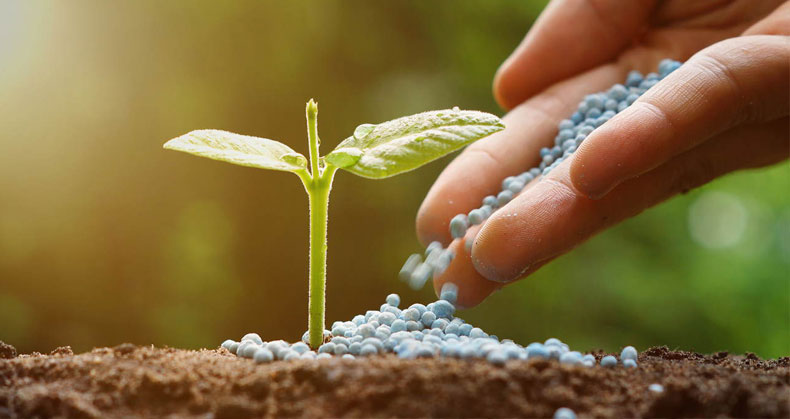
B. AGRICULTURAL FERTILIZER
Plants need nutrients to grow which they absorb from the soil via the plant’s root system. Fertilizers provide the major nutrients (nitrogen, phosphorus and potassium and important secondary elements) that plants need. Unless the nutrients are replenished, the soil’s productive capacity declines with every harves
Functional Fertilizers have a potentially positive effect in plants beyond basic nutrition.
Most fertilizers that are commonly used in agriculture contain the three basic plant nutrients: nitrogen, phosphorus, and potassium. Some fertilizers also contain certain “micronutrients,” such as zinc and other metals, that are necessary for plant growth.
In addition to carbon, hydrogen and oxygen, which they get from the atmosphere and water, plants need numerous essential nutrients for their growth and health, which fertilizers provide:
Nitrogen (N), phosphorus (P) and potassium (K) are the primary nutrients in commercial fertilizers.
Other plant nutrients are sulphur (S), magnesium (Mg), calcium (Ca), zinc (Zn), iron (Fe), boron (B), manganese (Mn), copper (Cu), molybdenum (Mo), chlorine (Cl), nickel (Ni), iodine (I). Additional plant nutrients are required by a few plant species, e.g., sodium (Na) and cobalt (Co).

Nitrogen fertilizer
Nitrogen fertilizer is a nitrogen-rich substance, either solid or liquid, widely used in agriculture to promote crop growth and unlock higher yields. Nitrogen (N) is a common component of fertilizers because it is essential for all plants to produce energy in their cells.
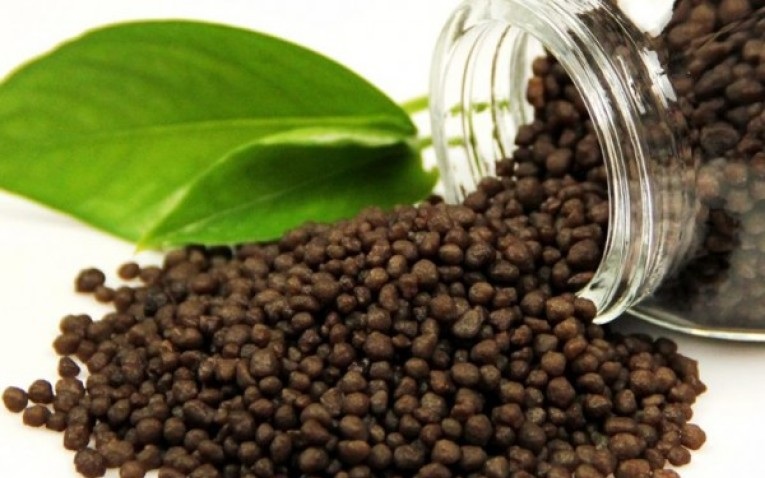
Phosphorus fertilizer
Phosphorus fertilizer is a nutrient-rich product that plays a crucial role in modern agriculture, supplying one of the three macronutrients essential for plant growth. As rain constantly washes phosphorus (P) from the soil, farmers rely on organic or synthetic fertilizers to replenish depleted reserves.
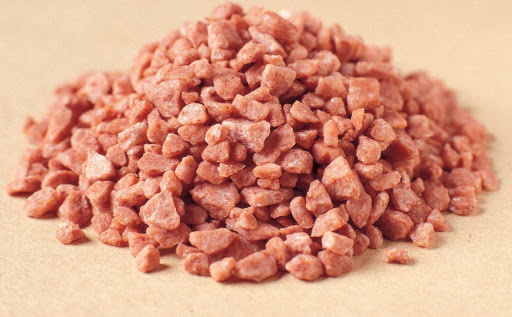
Potassium fertilizer
Potassium fertilizer refers to substances like KCl or potassium sulphate used to provide essential potassium to plants for optimal growth. It should be placed strategically in the soil to ensure efficient absorption by plant roots.

Mineral fertilizer plays an essential role in our food systems: it increases the volume of food that can be grown on a fixed amount of land.
Approximately half the food we eat today has been produced thanks to mineral fertilizer.
Mineral and organic fertilizers contain nutrients in different forms. Ultimately, however, because plants can only take up nutrients in their mineral form, the original fertilizer source makes no difference from a plant nutrition standpoint. No matter what the source, all nutrients are used in exactly the same way by plants with the same effec.
Inorganic fertilisers are usually more concentrated and faster acting than organic fertilisers. Examples of inorganic fertilisers include: Growmore, Miracle-Gro, Phostrogen, Sulphate of Ammonia, Sulphate of Potash, and Superphosphate and Tomorite Very aggresive action and a lot of risk to burn roots and plants when doses are not respected.
Fertilizers are critical agricultural inputs, providing essential nutrients to crop growth and development and to the preservation and enhancement of soil fertility. Nutrients can be delivered via organic (manure, compost) or mineral additions to the soil. Primary macro-nutrients delivered by mineral fertilizers, also referred to as inorganic fertilizers, include nitrogen, phosphorous, and potassium. Secondary nutrients include calcium, magnesium, and sulfur. Mineral fertilizer blends can also include micronutrients such as copper, manganese, and zinc. Globally, the most widely-deployed plant nutrients in agriculture are nitrogen, phosphorous, and potassium while the most widely used mineral fertilizer in the world is urea, accounting for more than 50% of global nitrogen fertilizer use.
We take up current trends and demands on the fertilizer industry. Plant Fiber Technology offers powerful effects in modern fertilizer products, as it contributes to process optimization and to controll their physical product properties. our products are applicable in all materials groups of the fertilizer industry.
We develope and produce functional plant fiber in the form of fine powders through to special granulates. Thanks to our unique grinding technology, we achieve unique particle and fiber structures that give your fertilizers tangible added value. Our organic products are purely plant-based.

